Abstract
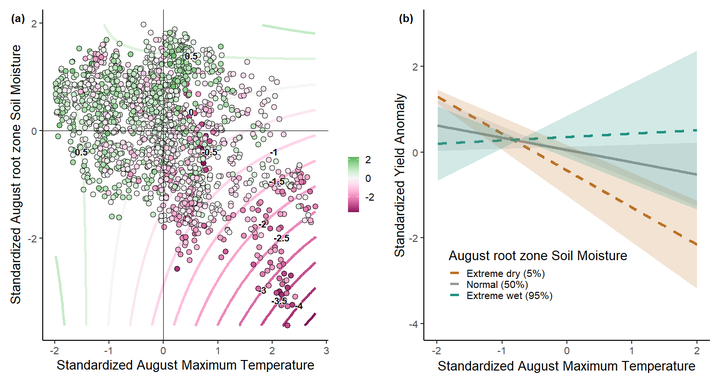
The US agriculture system supplies more than one-third of globally-traded soybean and with 90% of US soybean produced under rainfed agriculture, soybean trade is particularly sensitive to weather and climate variability. Average growing season climate conditions can explain about one-third of US soybean yield variability. Additionally, crops can be sensitive to specific short-term weather extremes, occurring in isolation or compounding at key moments throughout crop development. Here, we identify the dominant within-season climate drivers that can explain soybean yield variability in the US, and explore synergistic effects between drivers that can lead to severe impacts. The study combines weather data from reanalysis and satellite-informed root-zone soil moisture fields with sub-national crop yields using statistical methods that account for interaction effects. Our models can explain on average about two thirds of the year-to-year yield variability (70% on all years and 60% on out-of-sample predictions). The largest negative influence on soybean yields is driven by high temperature and low soil moisture during the summer crop reproductive period. Moreover, due to synergistic effects, heat is considerably more damaging to soybean crops during dry conditions, and less so during wet conditions. Compound and interacting hot and dry summer conditions (defined by the 95th and 5th percentiles of temperature and soil moisture, respectively) reduce yields by 2 standard deviation. This sensitivity is, respectively, 4 and 3 times larger than the sensitivity to hot or dry conditions alone. Other relevant drivers of negative yield responses are lower temperatures early and late in the season, excessive precipitation in early season and dry conditions in late season. The sensitivity to the identified drivers varies across the spatial domain with higher latitudes, and thus colder regions, positively affected by high temperature during the summer period. On the other hand, warmer south-eastern regions are positively affected by low temperature late season. Historic trends in identified drivers indicates that US soybean has generally benefited from recent shifts in weather except for increasing rainfall in the early season. Overall warming conditions have reduced the risk of frost in early and late-season and potentially allowed for earlier sowing dates. More importantly, summers have been getting cooler and wetter over eastern US. Still, despite these positive changes, we show that the frequency of compound hot-dry summer events has remained unchanged over 1946-2016. In the longer term, climate models project substantially warmer summers for the continental US but uncertainty remains whether this will be accompanied by drier conditions. This highlights a critical element to explore in future studies focused on US agricultural production risk under climate change.